Imagining the future of home with AI and Edge intelligence
Role:
Concept / UX
Year:
2025/26
Context
From connected devices to an intelligent home
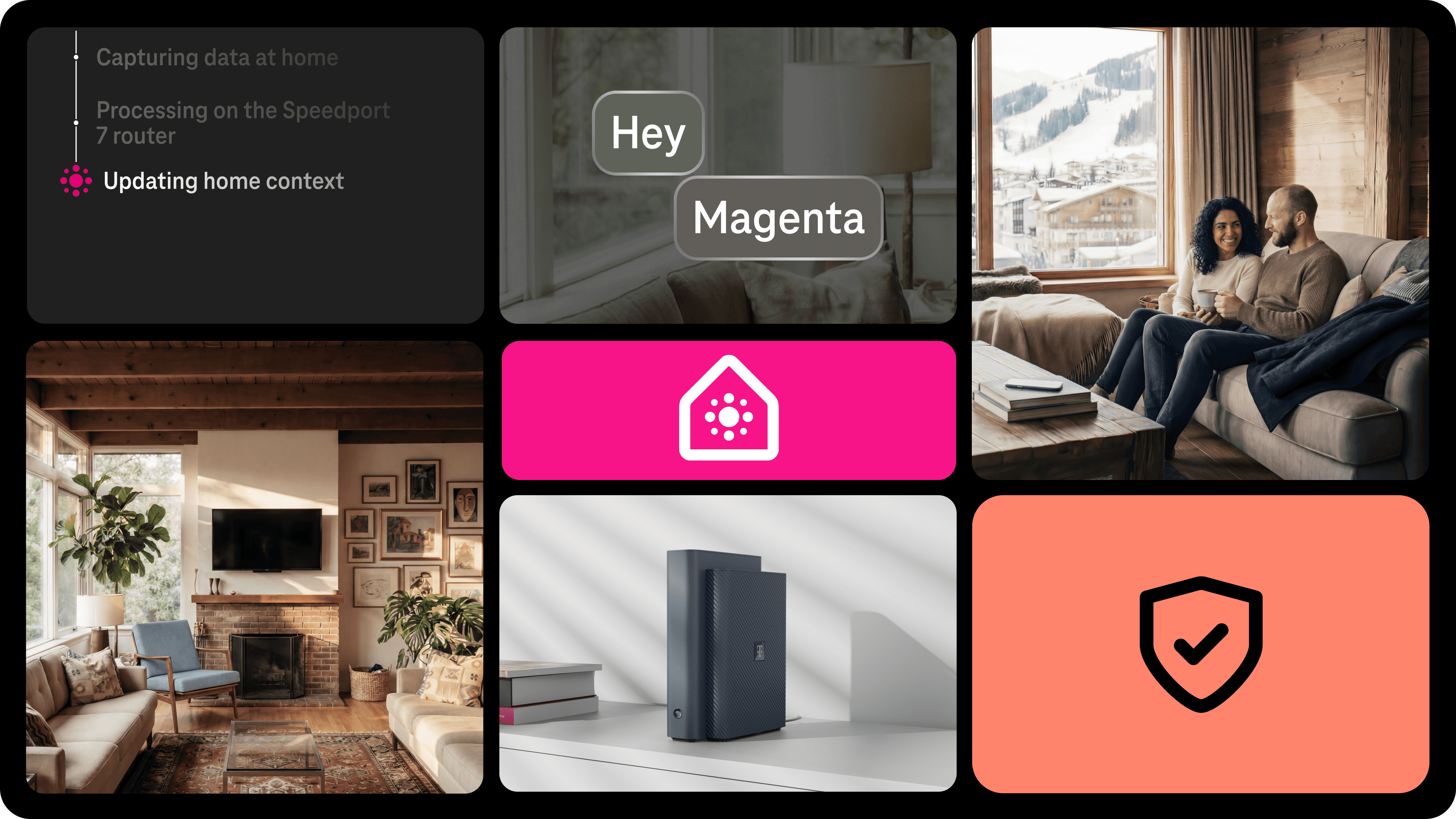
Deutsche Telekom's home business runs on connectivity. Broadband, routers, smart devices. For years the product question was how to help people manage what they already had.
In 2025, new hardware changed what was possible. Routers with embedded Neural Processing Units, edge-AI TV set-top boxes with far-field microphones, and a growing Telekom hardware ecosystem meant intelligence could now live inside the home network. No data leaving the house.
The question shifted: if the home can think locally, what should it do for the people living in it? I joined a small innovation team to explore that. The output would be presented at Mobile World Congress.
Note: Due to NDA restrictions, only high-level insights and conceptual representations are shared.
Deutsche Telekom's home business runs on connectivity. Broadband, routers, smart devices. For years the product question was how to help people manage what they already had.
In 2025, new hardware changed what was possible. Routers with embedded Neural Processing Units, edge-AI TV set-top boxes with far-field microphones, and a growing Telekom hardware ecosystem meant intelligence could now live inside the home network. No data leaving the house.
The question shifted: if the home can think locally, what should it do for the people living in it? I joined a small innovation team to explore that. The output would be presented at Mobile World Congress.
Note: Due to NDA restrictions, only high-level insights and conceptual representations are shared.
The insight
Smart is not the same as intelligent
Every smart home product was built around the same idea: give people control. Better dashboards. Easier automation. More settings. The whole market was optimising for someone with the time and confidence to manage everything.
But that person doesn't really exist. An elderly person living alone doesn't want a dashboard. A family with young kids doesn't have time to configure routines. A couple travelling abroad needs the home to handle something unexpected without being remote-controlled from another timezone.
Every smart home product was built around the same idea: give people control. Better dashboards. Easier automation. More settings. The whole market was optimising for someone with the time and confidence to manage everything.
But that person doesn't really exist. An elderly person living alone doesn't want a dashboard. A family with young kids doesn't have time to configure routines. A couple travelling abroad needs the home to handle something unexpected without being remote-controlled from another timezone.
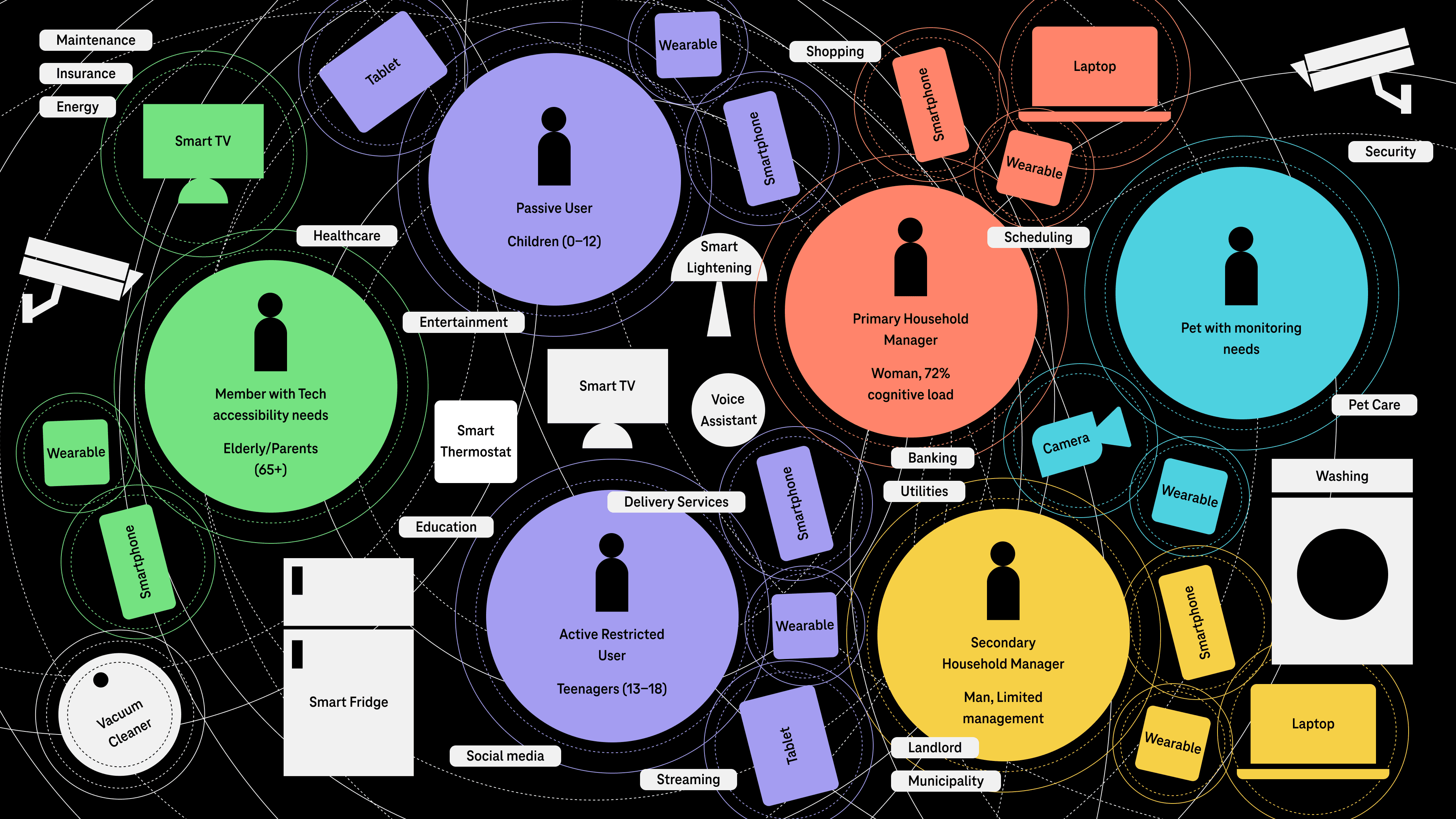
Smart homes respond to commands. An intelligent home understands your life.
Smart homes respond to commands. An intelligent home understands your life.
The gap was context. Current products have no picture of your day. They respond to commands because commands are all they have. Edge AI changed that.
The gap was context. Current products have no picture of your day. They respond to commands because commands are all they have. Edge AI changed that.
Concept
A home that builds context over time
Magenta Intelligent Home is an AI layer running across Telekom's hardware ecosystem. The edge-AI router, the set-top box with far-field microphones, MagentaTV, and mobile all work together to build context from routines and calendar, and act on behalf of the people living there.
The first design decision was also the most important: no app. The home communicates through voice and uses whichever surface fits the moment. A morning update through the speaker. A network alert on the TV. A quick override from your phone. The interaction follows you. You don't go to it.
Magenta Intelligent Home is an AI layer running across Telekom's hardware ecosystem. The edge-AI router, the set-top box with far-field microphones, MagentaTV, and mobile all work together to build context from routines and calendar, and act on behalf of the people living there.
The first design decision was also the most important: no app. The home communicates through voice and uses whichever surface fits the moment. A morning update through the speaker. A network alert on the TV. A quick override from your phone. The interaction follows you. You don't go to it.
Concept Framework
The foundations of an intelligent home
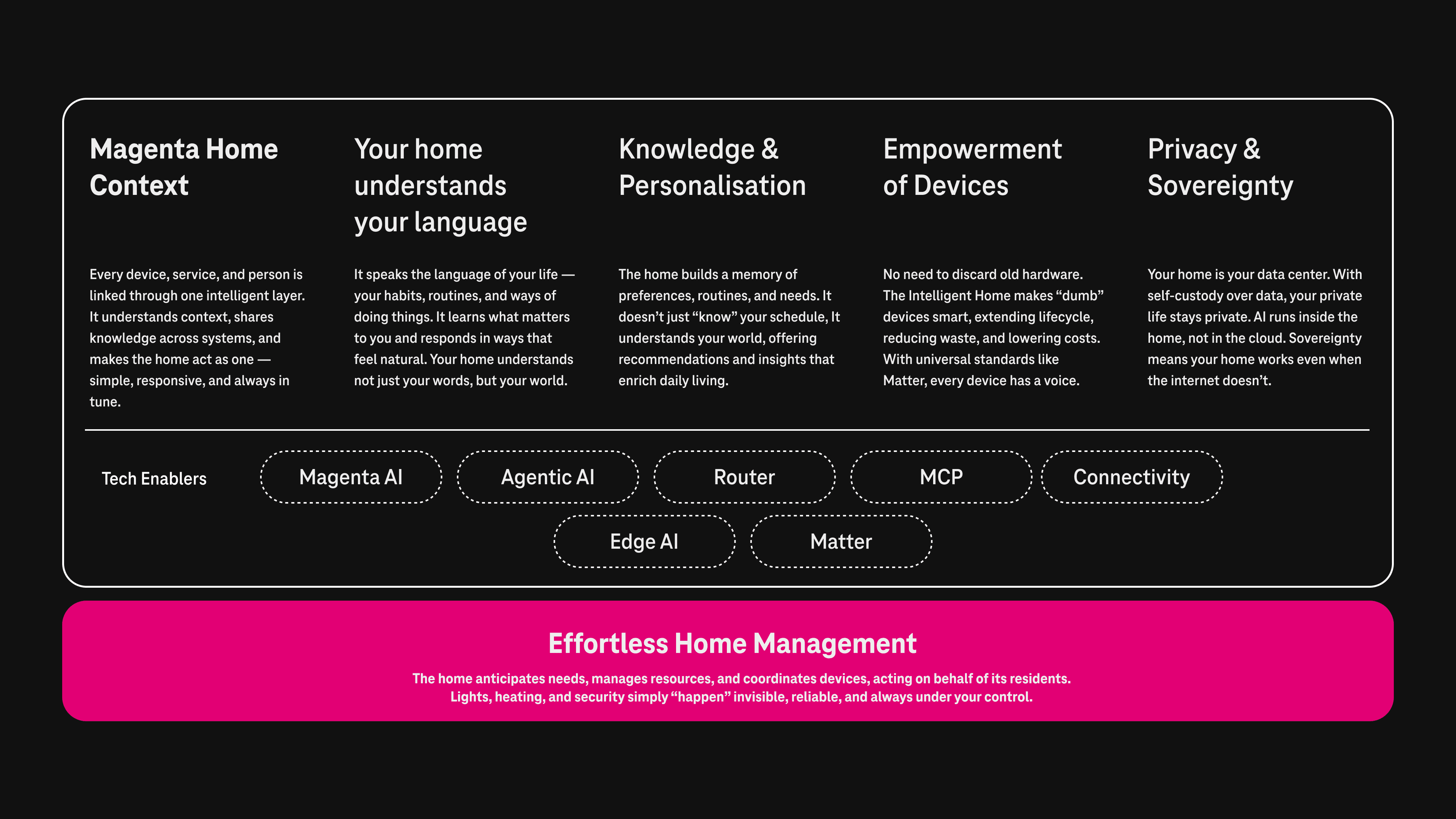
To translate this vision into a tangible system, we defined a set of design pillars that guide how the intelligent home should behave and what value it provides to residents.
To translate this vision into a tangible system, we defined a set of design pillars that guide how the intelligent home should behave and what value it provides to residents.
The scenarios
Three moments that made the concept real
The concept was built around people, not features. We mapped out a range of household situations, then chose three to develop and showcase at MWC. Each was visualised using AI-generated imagery and video.
The concept was built around people, not features. We mapped out a range of household situations, then chose three to develop and showcase at MWC. Each was visualised using AI-generated imagery and video.
MWC showcase
From concept to stage
The three scenarios were presented as an immersive installation at Deutsche Telekom's MWC booth — putting a global audience inside the concept through the lens of real people's lives.
The three scenarios were presented as an immersive installation at Deutsche Telekom's MWC booth — putting a global audience inside the concept through the lens of real people's lives.
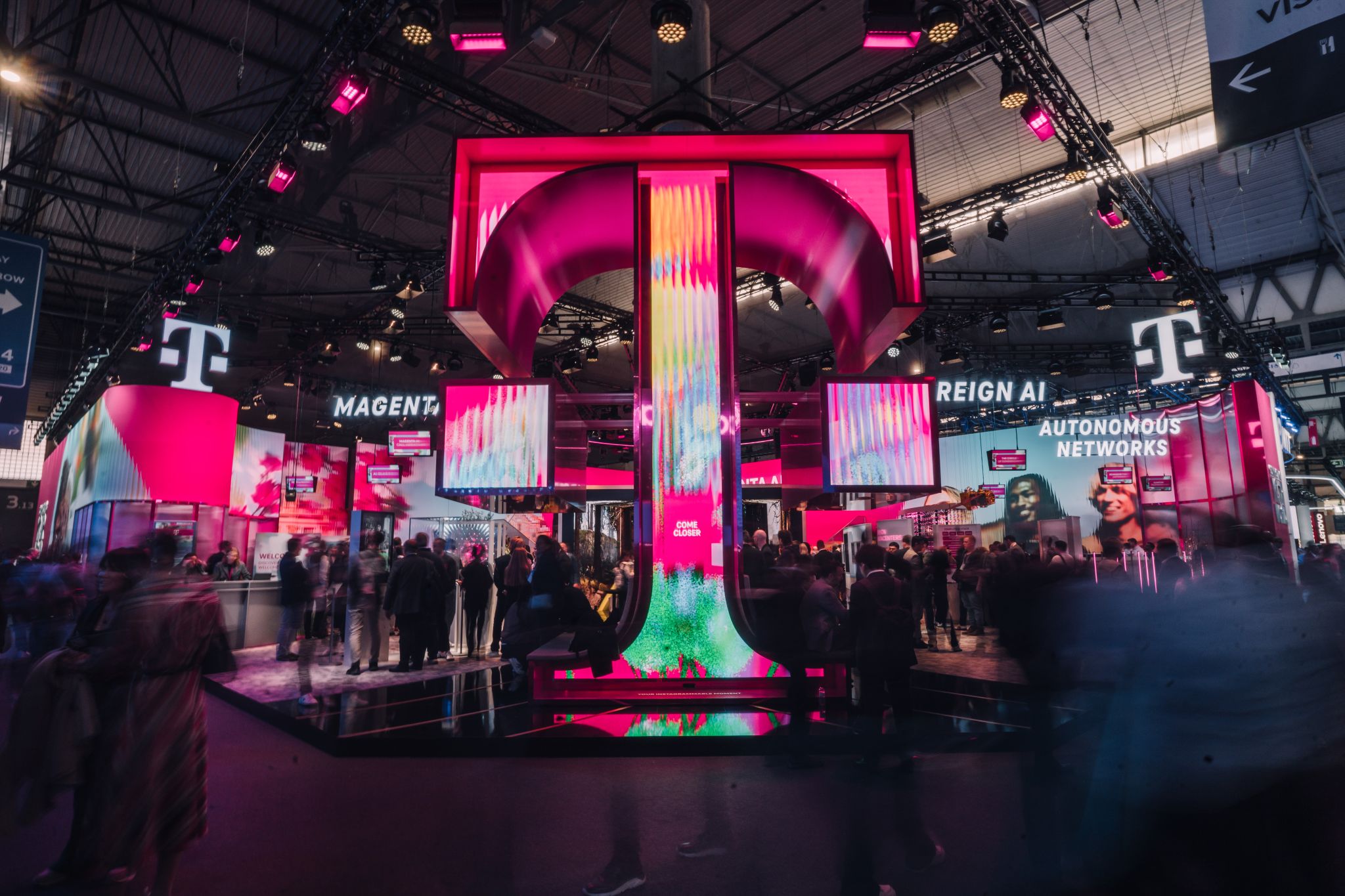
Deutsche Telekom’s showcase at Mobile World Congress, presenting future visions for AI-powered connectivity and intelligent living.
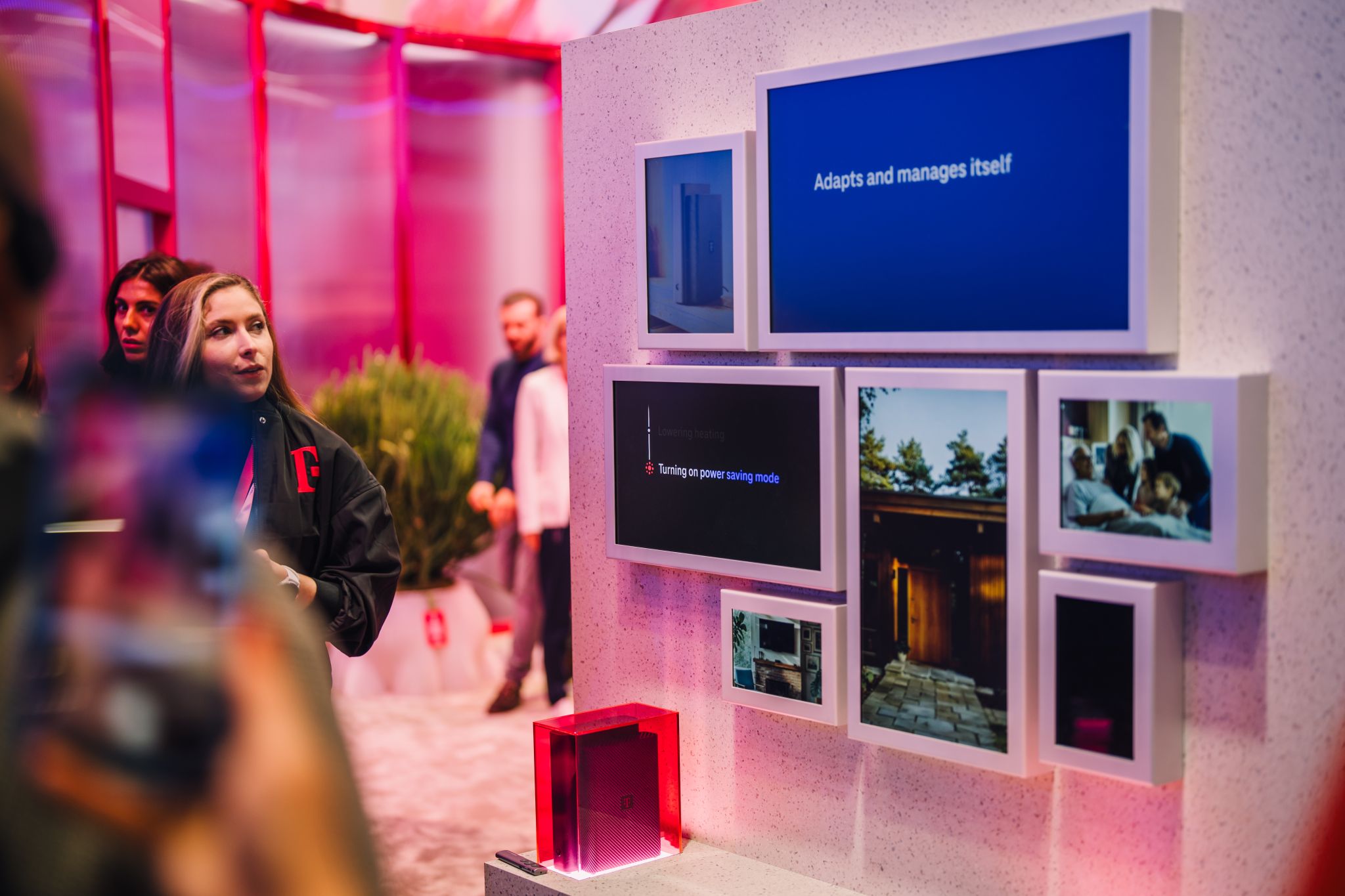
Concept installation illustrating Magenta Intelligent Home—an AI system that learns routines and manages home environments autonomously.
Reflection
From exploration to strategic direction
This was conceptual work. There are no shipped metrics.
What it produced: a concept prototype, experience principles, and three visualised scenarios presented at MWC to an international audience of telecom leaders and technology press. The privacy-by-architecture model entered conversations about how edge computing could differentiate Deutsche Telekom's home offering from cloud-first competitors.
This was conceptual work. There are no shipped metrics.
What it produced: a concept prototype, experience principles, and three visualised scenarios presented at MWC to an international audience of telecom leaders and technology press. The privacy-by-architecture model entered conversations about how edge computing could differentiate Deutsche Telekom's home offering from cloud-first competitors.
What's next
Directions worth pursuing
Designing for multiple people
All three scenarios assumed one household unit with aligned needs. Real homes have people with conflicting routines. How does the system learn all of them without defaulting to whoever set it up first?
Designing for multiple people
All three scenarios assumed one household unit with aligned needs. Real homes have people with conflicting routines. How does the system learn all of them without defaulting to whoever set it up first?
Designing for multiple people
All three scenarios assumed one household unit with aligned needs. Real homes have people with conflicting routines. How does the system learn all of them without defaulting to whoever set it up first?
Building trust gradually
The concept assumed people would accept a home that acts without being asked. Earning that trust, narrating early and going quiet later, is the interaction design problem we didn't fully resolve.
Building trust gradually
The concept assumed people would accept a home that acts without being asked. Earning that trust, narrating early and going quiet later, is the interaction design problem we didn't fully resolve.
Beyond Telekom hardware
The concept was scoped to Telekom's own device stack. The bigger question is how an intelligent layer like this works when half the devices in the home aren't yours.
Beyond Telekom hardware
The concept was scoped to Telekom's own device stack. The bigger question is how an intelligent layer like this works when half the devices in the home aren't yours.
Beyond Telekom hardware
The concept was scoped to Telekom's own device stack. The bigger question is how an intelligent layer like this works when half the devices in the home aren't yours.
Reflection
What this project changed
Two years on one project leaves a mark. Some of what I take away is what I'd do differently. Some of it changed how I work for good. The four below are the ones I keep coming back to.
Two years on one project leaves a mark. Some of what I take away is what I'd do differently. Some of it changed how I work for good. The four below are the ones I keep coming back to.
Lead with a person, not a product
The concept clicked when we stopped describing what the system could do and started showing who it was for. The elderly woman. The couple abroad. The family on a Tuesday morning. Each scenario made the concept feel real in a way no feature list could. I carry that into every vision and strategy project now.
Open briefs need a real anchor
A brief this open can produce work that feels visionary but floats. What kept this project grounded was specific hardware that was actually shipping. The NPU router, the far-field set-top box. That gave every concept a floor. I'd look for that anchor earlier next time.
The tools you use are part of the story
Using AI to visualise an AI concept wasn't just efficient. It was honest. The technology we were designing with was the same technology we were designing for. That made the work more credible on stage than polished hand-crafted renders would have.
More case studies
LET'S CONNECT
Let's create something amazing together
I'm always excited to discuss new opportunities and ideas. Drop me a line. :)
© 2025 Adiy Bin Yunus / Made with ❤️🔥 in Berlin
LET'S CONNECT
Let's create something amazing together
I'm always excited to discuss new opportunities and ideas. Drop me a line. :)
© 2025 Adiy Bin Yunus / Made with ❤️🔥 in Berlin
LET'S CONNECT
Let's create something amazing together
I'm always excited to discuss new opportunities and ideas. Drop me a line. :)
© 2025 Adiy Bin Yunus / Made with ❤️🔥 in Berlin