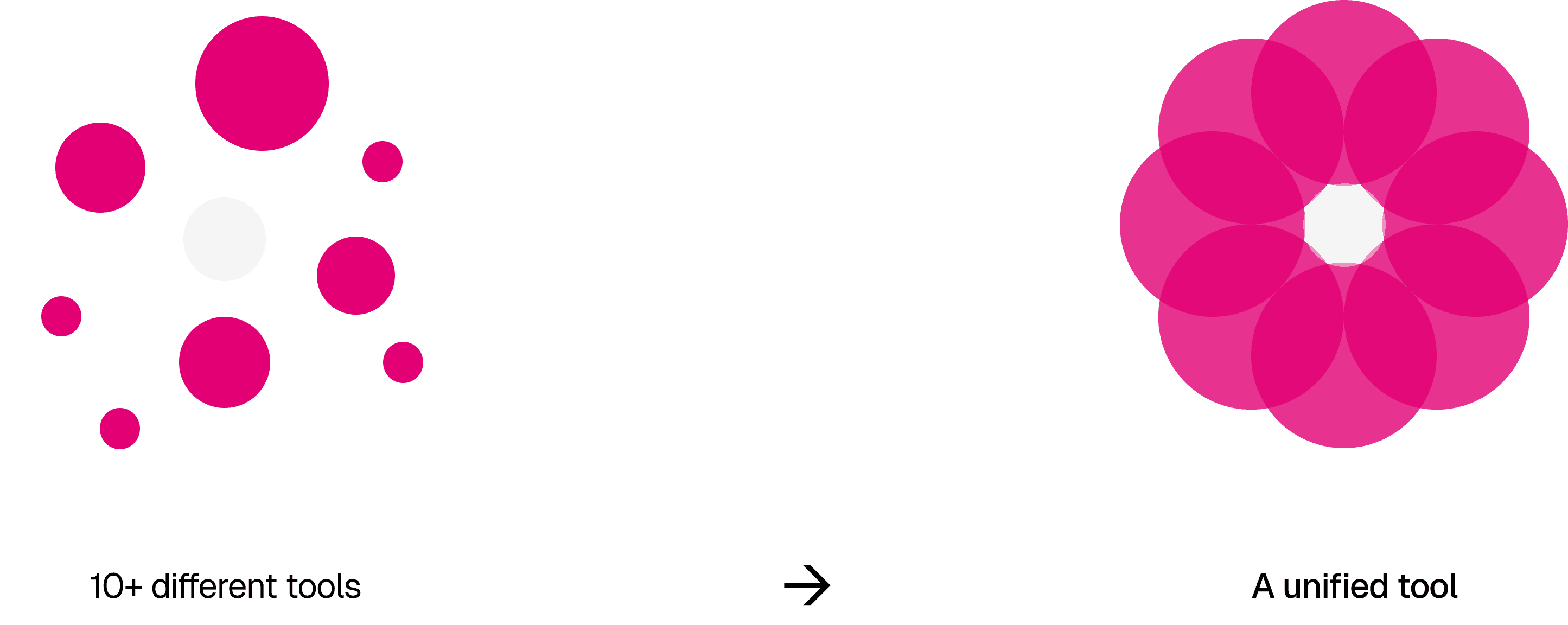
From Fragmented Tools to a Single Service Experience

Consolidating 10+ legacy tools into one platform for 20,000 agents handling 86 million customer contacts a year — and rebuilding the structural foundation to make it actually work at scale.

Role:

UX / Strategy

Year:

2023/24

12.5%

Reduction in avg call time

28→37

NPS improvement

10.6k

Active users, up from 4.5k

12.5%

Reduction in avg call time

28→37

NPS improvement

10.6k

Active users, up from 4.5k

Context

From MVP validation to operational platform

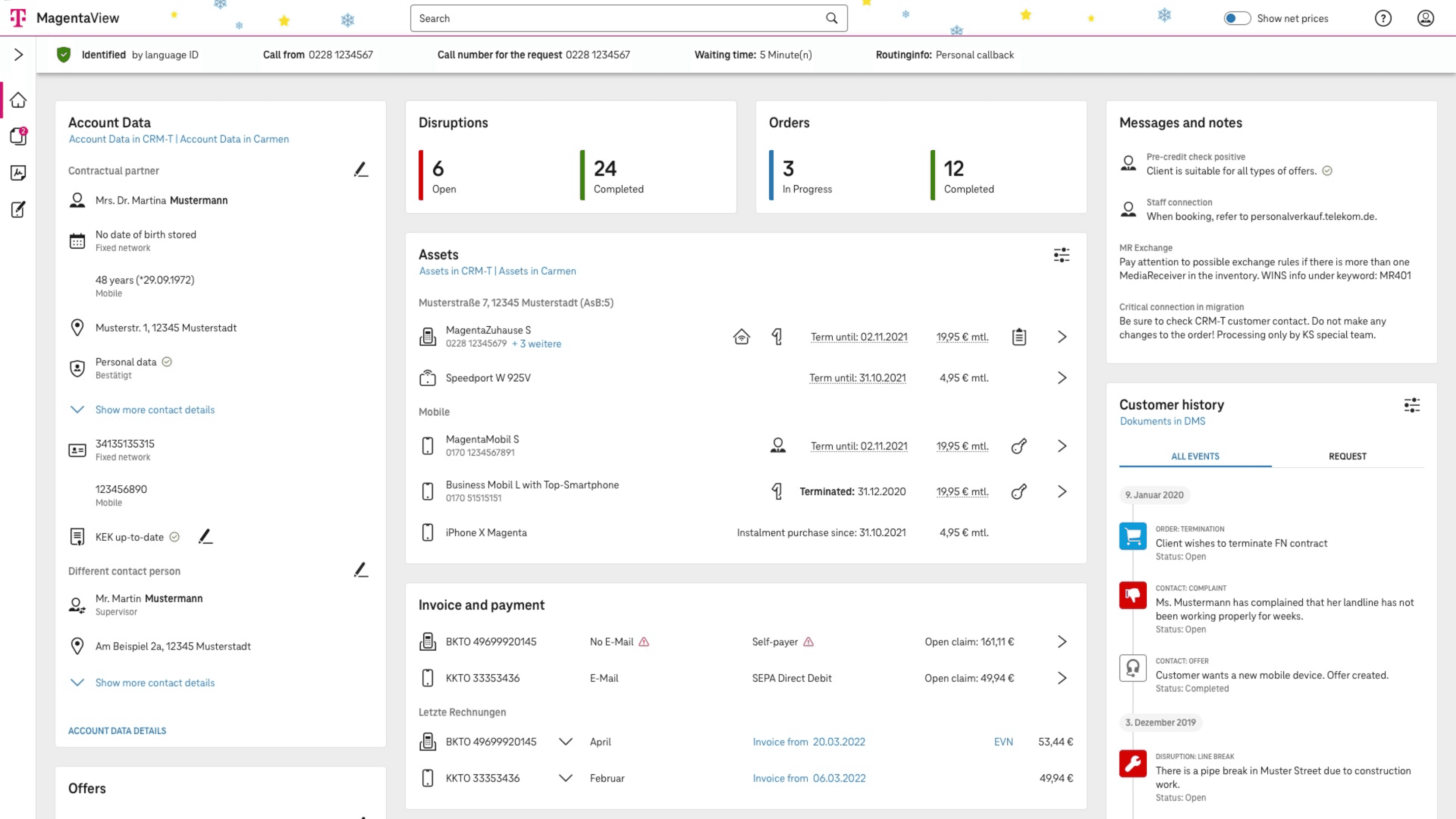
Telekom's call centres handle approximately 86 million customer contacts per year, supported by around 20,000 agents. Workflow efficiency directly affects call handling time, customer satisfaction, and operational cost at scale.

The MVP proved core workflows could live in one platform. The next phase was harder: making it a tool agents would trust and use daily, across call centre and retail environments, while rolling out across European markets.

Context

From MVP validation to operational platform

Telekom's call centres handle approximately 86 million customer contacts per year, supported by around 20,000 agents. Workflow efficiency directly affects call handling time, customer satisfaction, and operational cost at scale.

The MVP proved core workflows could live in one platform. The next phase was harder: making it a tool agents would trust and use daily, across call centre and retail environments, while rolling out across European markets.

Adoption was the real challenge. Without agent trust, consolidation would fail regardless of how well the product was designed.

My role

Product design ownership across the platform's core

I was one of eight designers on the platform. I owned the two areas most critical to whether the platform held together structurally: navigation architecture and customer authentication — end to end, from research through to shipped product.

Beyond my owned work, I led the definition of UX consistency patterns used across all modules, and coordinated with engineering teams and compliance stakeholders to maintain coherence as the platform scaled.

My role

Product design ownership across the platform's core

I was one of eight designers on the platform. I owned the two areas most critical to whether the platform held together structurally: navigation architecture and customer authentication — end to end, from research through to shipped product.

Beyond my owned work, I led the definition of UX consistency patterns used across all modules, and coordinated with engineering teams and compliance stakeholders to maintain coherence as the platform scaled.

Understanding Real Workflows

Observing how agents actually work

I spent time observing agents in both call centre and retail environments before redesigning anything. The two contexts are fundamentally different.

In call centres, agents juggle multiple information threads simultaneously while a customer is on the line. In retail, agents work on tablets in landscape mode directly in front of customers — changing both privacy requirements and interaction patterns entirely.

Three things became clear:

The mandatory dashboard return was breaking task continuity — agents looped Dashboard → Section → Back dozens of times per call

Navigation structure was directly causing inefficiency, not feature gaps

Small interaction delays compound fast at this call volume

Understanding Real Workflows

Observing how agents actually work

I spent time observing agents in both call centre and retail environments before redesigning anything. The two contexts are fundamentally different.

In call centres, agents juggle multiple information threads simultaneously while a customer is on the line. In retail, agents work on tablets in landscape mode directly in front of customers — changing both privacy requirements and interaction patterns entirely.

Three things became clear:

The mandatory dashboard return was breaking task continuity — agents looped Dashboard → Section → Back dozens of times per call

Navigation structure was directly causing inefficiency, not feature gaps

Small interaction delays compound fast at this call volume

"I keep going back to the dashboard even when I know where I want to go."

The hard call

Foundation before features — a strategic disagreement

The organisational pressure was to ship more: sales journeys, new modules, more coverage. Management's argument was reasonable — more functionality would drive adoption faster.

We disagreed. Agents wouldn't trust a tool that slowed them every day. Our case: fix the foundation first, make agents faster at resolving issues, and adoption would follow. Several sales journeys were delayed to resource this work. That was a real cost.

The hard call

Foundation before features — a strategic disagreement

The organisational pressure was to ship more: sales journeys, new modules, more coverage. Management's argument was reasonable — more functionality would drive adoption faster.

We disagreed. Agents wouldn't trust a tool that slowed them every day. Our case: fix the foundation first, make agents faster at resolving issues, and adoption would follow. Several sales journeys were delayed to resource this work. That was a real cost.

What it actually took to ship

This wasn't a design decision — it was a coordination problem. The navigation shell was owned by the design system team. Every module team — assets, orders, billing — had to rebuild their secondary pages and wire into the new structure. Each team had their own roadmap and engineering constraints.The hardest part: each module team saw this as additional work with no direct impact on their own metrics. The only way to move it forward was to make the shared case — that every module's adoption depended on the container working properly. Navigation isn't owned by any one team, which means everyone deprioritises it unless someone holds the line.We held the line. It took almost a year from decision to launch.

What we gave up

Several sales journeys were delayed to resource this work. That was a real cost, and management felt it. The bet was that usability improvements would drive more durable adoption than feature volume. The 12.5% reduction in call handling time and NPS moving from 33 to 44 validated the trade-off — but we didn't have those numbers when we made the call.

Navigation

Persistent tabs as the structural backbone

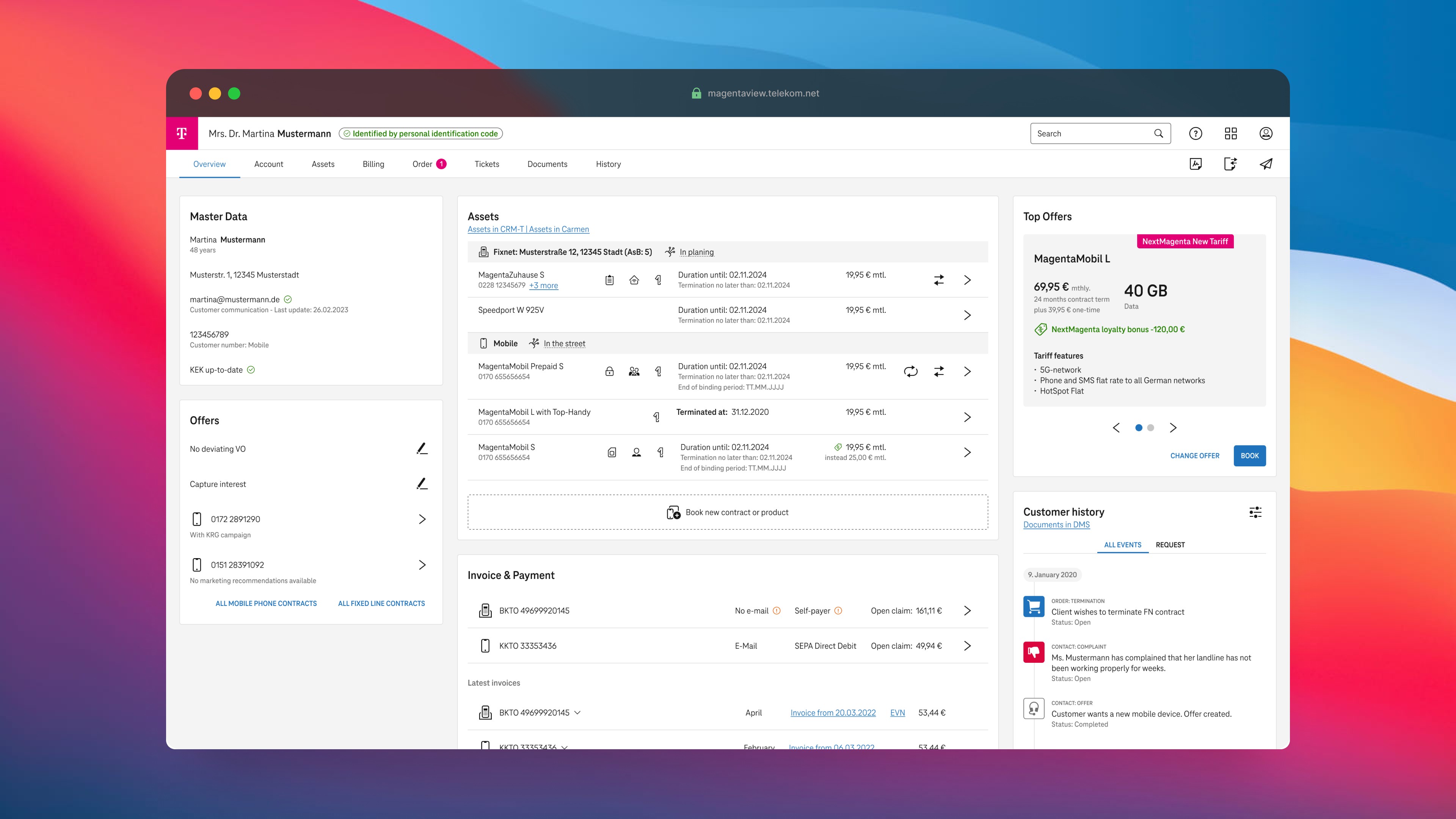
The dashboard became a starting point, not a mandatory waypoint. Agents could move directly between customer sections — overview, assets, billing, history — without losing position. Every new module would be built on this structure.

Navigation

Persistent tabs as the structural backbone

The dashboard became a starting point, not a mandatory waypoint. Agents could move directly between customer sections — overview, assets, billing, history — without losing position. Every new module would be built on this structure.

Customer Authentication

Two environments, two different access problems

In call centres, agents can view customer data before authentication. In retail shops, they cannot — they're working directly in front of the customer. One platform had to handle both without two separate interaction models.

Agents were accustomed to authentication sitting at the top from the MVP. We kept that — evolving rather than replacing — and added fallback options for edge cases and stricter controls for retail. After authentication, agents can click the customer's name to access a quick summary: reason for call, IVR data, and AI-collected context, reducing time spent re-establishing context at the start of every interaction

Customer Authentication

Two environments, two different access problems

In call centres, agents can view customer data before authentication. In retail shops, they cannot — they're working directly in front of the customer. One platform had to handle both without two separate interaction models.

Agents were accustomed to authentication sitting at the top from the MVP. We kept that — evolving rather than replacing — and added fallback options for edge cases and stricter controls for retail. After authentication, agents can click the customer's name to access a quick summary: reason for call, IVR data, and AI-collected context, reducing time spent re-establishing context at the start of every interaction

UX Consistency

Shared patterns across eight designers and multiple engineering teams

Without deliberate intervention, inconsistency was the default at this scale. We ran weekly design pattern calls where the team aligned on emerging patterns. When something repeated across modules, one or two designers took ownership — researched it, defined it, pitched it for consensus.

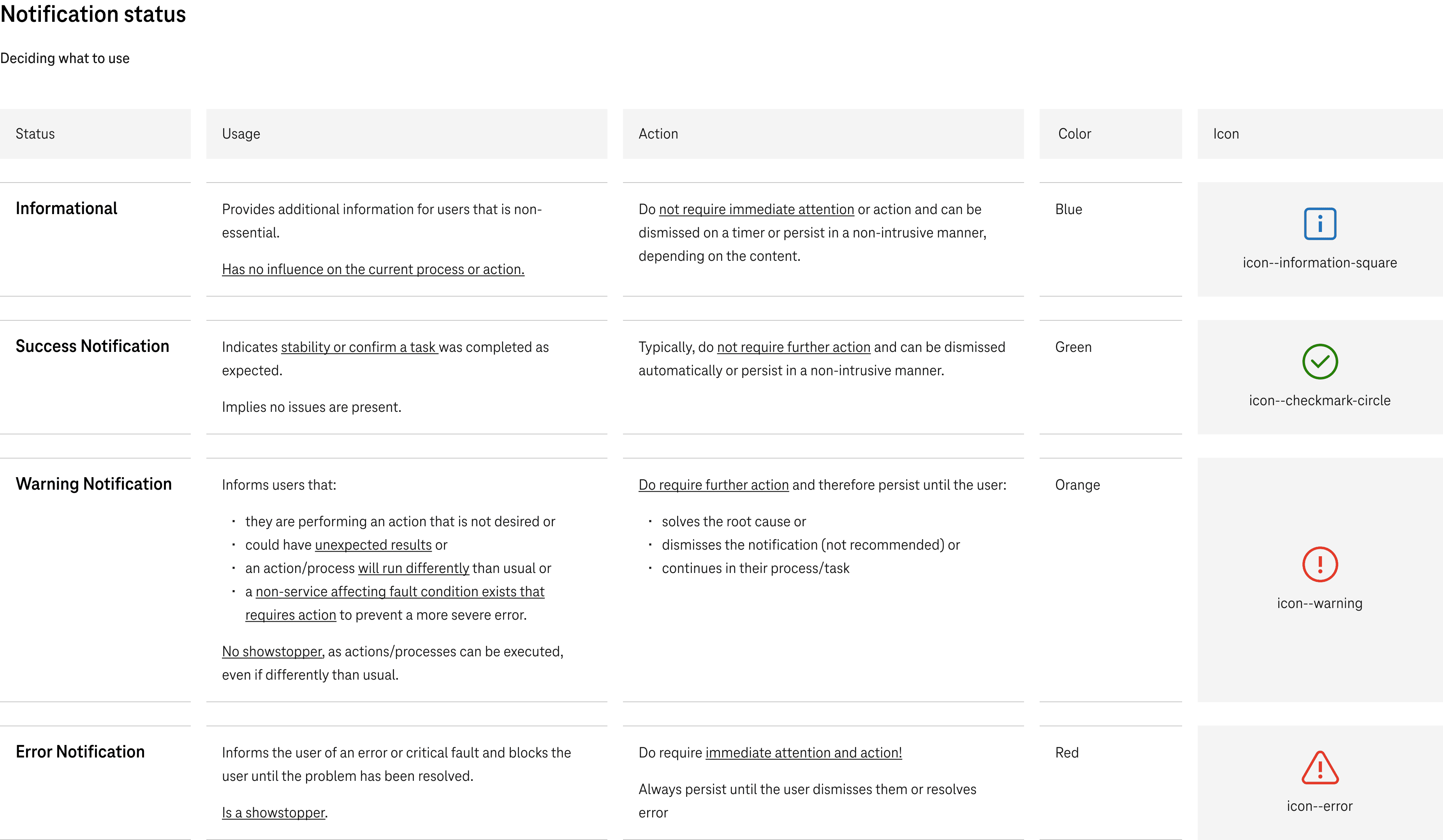
I defined patterns across the three highest-impact areas: navigation state behaviour, notification types (informational, success, warning, error), and authentication state feedback. These gave every new module a foundation to build on without re-solving what the team had already solved.

UX Consistency

Shared patterns across eight designers and multiple engineering teams

Without deliberate intervention, inconsistency was the default at this scale. We ran weekly design pattern calls where the team aligned on emerging patterns. When something repeated across modules, one or two designers took ownership — researched it, defined it, pitched it for consensus.

I defined patterns across the three highest-impact areas: navigation state behaviour, notification types (informational, success, warning, error), and authentication state feedback. These gave every new module a foundation to build on without re-solving what the team had already solved.

Real Constraints

Accessibility, compliance, and things that didn't ship cleanly

Approximately 10% of Telekom's call centre workforce relies on assistive technologies, per the workers council. This shaped structural decisions — the authentication flow is one example. For screen reader users, each step needed explicit state feedback and a clear focus path, otherwise the flow became disorienting mid-task. Compliance wasn't retrofitted. It changed how the interaction was built.

Not everything shipped on time. Critical edge cases caught late, backend issues, and API performance problems caused delays after launch. Real costs of building at this scale — and a reminder that design decisions don't exist in isolation from engineering constraints.

Real Constraints

Accessibility, compliance, and things that didn't ship cleanly

Approximately 10% of Telekom's call centre workforce relies on assistive technologies, per the workers council. This shaped structural decisions — the authentication flow is one example. For screen reader users, each step needed explicit state feedback and a clear focus path, otherwise the flow became disorienting mid-task. Compliance wasn't retrofitted. It changed how the interaction was built.

Not everything shipped on time. Critical edge cases caught late, backend issues, and API performance problems caused delays after launch. Real costs of building at this scale — and a reminder that design decisions don't exist in isolation from engineering constraints.

Reflection

What I learned, what I'd do differently

Decision-making was slower than it needed to be. With a large cross-functional team, every structural decision needed multiple alignment rounds. What I'd do differently: establish earlier which decisions need full consensus, which I can make and communicate, and which need escalation. I spent time seeking alignment on decisions I could have owned.

Working across cultures changed how I communicate. Communication styles varied significantly — in directness, in how feedback was given, in what "alignment" even meant. I had to adapt per stakeholder and be more deliberate about expectation management than good design work alone required.

Accessibility became a design quality, not a checklist. With 70% compliance as a hard launch gate, it shaped structural decisions from the start. Designing authentication for screen readers forced clearer thinking about state and sequence — improvements that made the flow better for everyone. Hearing from blind users that they could use the tool confidently made that concrete.

The pattern I should have defined first: notifications. I defined it mid-project, after inconsistency had already appeared across modules. If I started again, notification and error state patterns would be the first system-level work — before module development scaled up, not during it.

Reflection

What I learned, what I'd do differently

Decision-making was slower than it needed to be. With a large cross-functional team, every structural decision needed multiple alignment rounds. What I'd do differently: establish earlier which decisions need full consensus, which I can make and communicate, and which need escalation. I spent time seeking alignment on decisions I could have owned.

Working across cultures changed how I communicate. Communication styles varied significantly — in directness, in how feedback was given, in what "alignment" even meant. I had to adapt per stakeholder and be more deliberate about expectation management than good design work alone required.

Accessibility became a design quality, not a checklist. With 70% compliance as a hard launch gate, it shaped structural decisions from the start. Designing authentication for screen readers forced clearer thinking about state and sequence — improvements that made the flow better for everyone. Hearing from blind users that they could use the tool confidently made that concrete.

The pattern I should have defined first: notifications. I defined it mid-project, after inconsistency had already appeared across modules. If I started again, notification and error state patterns would be the first system-level work — before module development scaled up, not during it.

Looking for a designer who's shipped at scale and can own a product area from day one?

© 2025 Adiy Bin Yunus / Made with ❤️‍🔥 in Berlin

Looking for a designer who's shipped at scale and can own a product area from day one?

© 2025 Adiy Bin Yunus / Made with ❤️‍🔥 in Berlin

Looking for a designer who's shipped at scale and can own a product area from day one?

© 2025 Adiy Bin Yunus / Made with ❤️‍🔥 in Berlin